
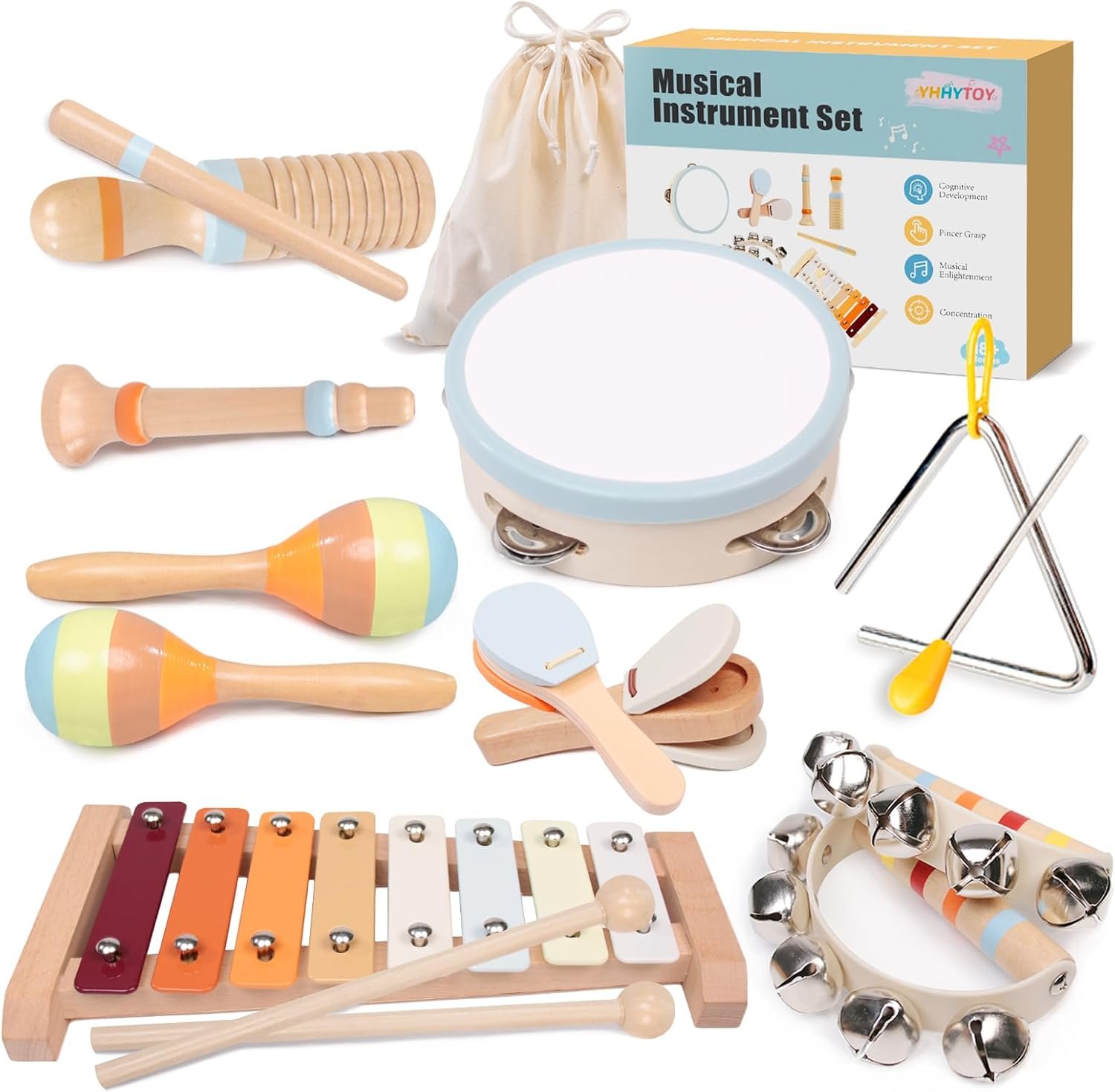
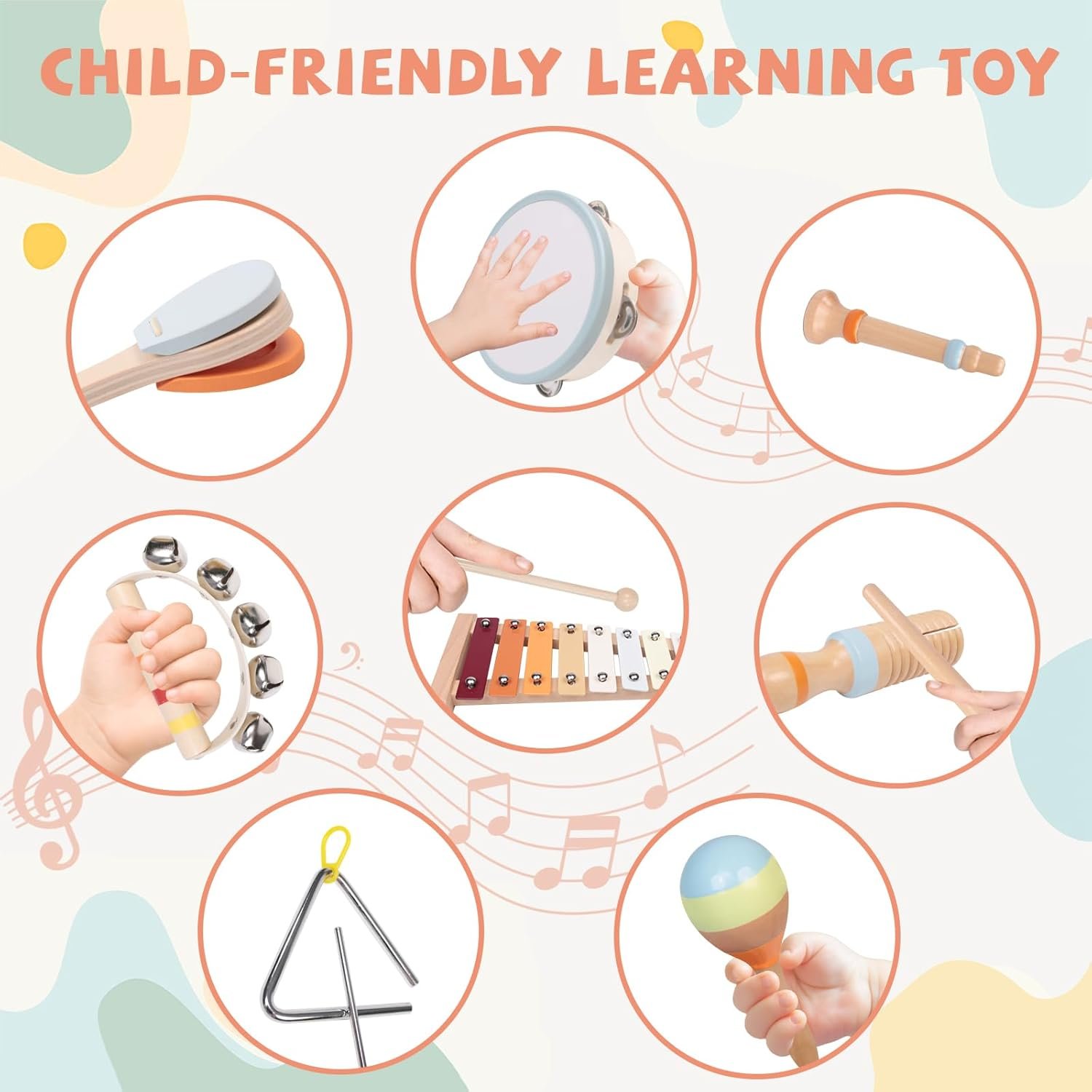
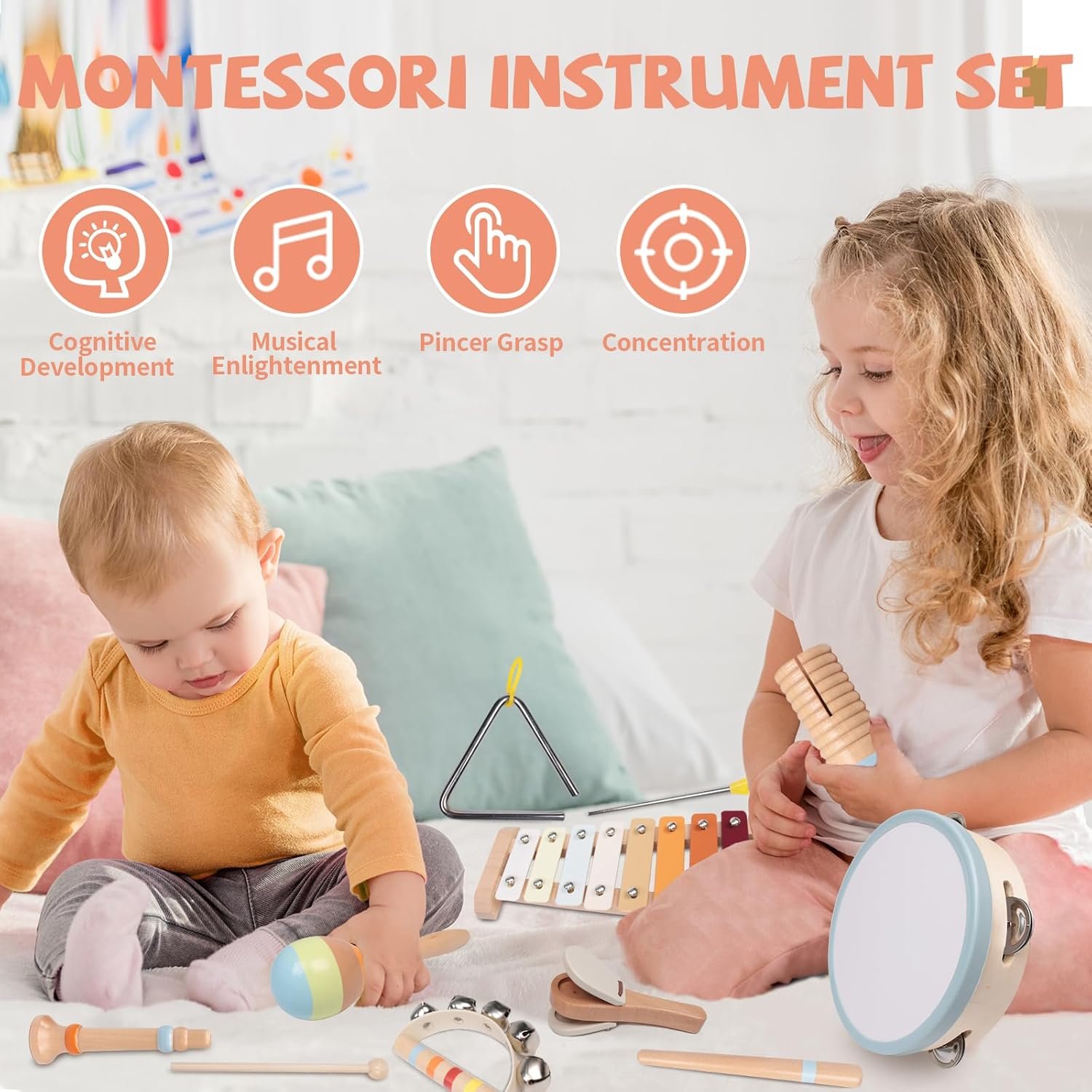
The Montessori Baby Musical Instruments Set features 10 beautifully crafted wooden percussion toys, including maracas, tambourines, and xylophones, designed for sensory exploration and motor-skill development. Made from natural wood with non-toxic paint, this eco-friendly kit introduces rhythm and sound safely to little learners. Loved by parents for its quality and creativity, it holds a strong 4.7-star Amazon rating, making it an ideal educational gift for babies and toddlers.

Baby Musical Instruments Set – Best Montessori Wooden 18 Month Old Baby Musical Toys
- Overall Rating
- Safety & Material Quality
- Educational & Development Value
- Design & Aesthetic Appeal
- Ease of Handling & Storage
4.7/5Overall Score
Specs
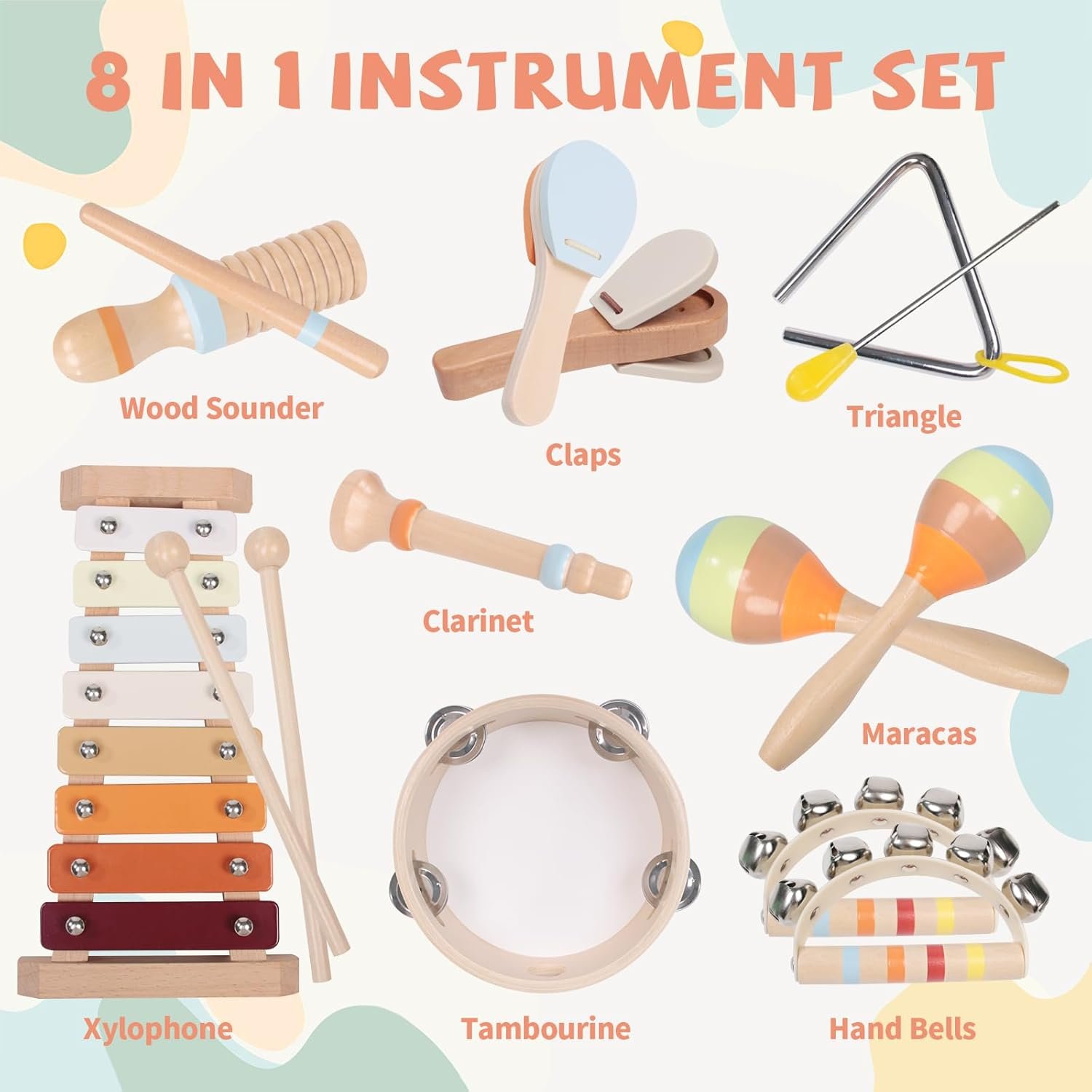
- Set Includes: 10 wooden instruments (tambourine, maracas, xylophone, shaker, castanets, etc.)
- Material: Premium natural wood, water-based paint, BPA-free finish
- Recommended Age: 6 months – 3 years
- Educational Focus: Rhythm, auditory recognition, fine motor skills
Pros
- Montessori-inspired educational design
- Durable, non-toxic natural wood
- Wide range of instruments for sensory play
- Encourages rhythm and hand coordination
- Montessori-inspired Beautifully finished and safe for small handsdesign
Cons
- May be too basic for older children
- Some instruments (e.g., clarinet) may have limited functionality compared to adult-instruments
- Storage bag may not be very durable
Why Early Music Play Matters So Much
Music is one of the earliest forms of communication babies respond to. Long before toddlers can speak, they feel rhythm, respond to tone, and copy simple beats with their hands. This is why introducing a baby musical instruments set makes such a big difference in early development. Sound play encourages experimentation, emotional expression, and coordination—all wrapped inside joyful, simple interactions that feel natural to babies.
Montessori philosophy supports this kind of hands-on exploration. Instead of complex electronics or overstimulating flashing toys, Montessori-based instruments focus on real textures, natural materials, intentional sound, and open-ended play. Babies learn more deeply when they can hold an object, shake it, tap it, or explore it without being guided by buttons or screens.
What Makes This Montessori Percussion Set Stand Out
This particular baby musical instruments set is built around Montessori values—purposeful movement, real sound, and natural materials. Instead of plastic pieces, the kit uses smooth, non-toxic wood shaped into maracas, tambourines, a xylophone, castanets, and hand bells that make authentic tones.
What parents love most is the warm, natural sound. No tinny noise, no harsh rattling—just gentle musical tones perfectly suited to a toddler’s sensitive ears. As babies shake, tap, and experiment, they hear direct feedback from their actions, reinforcing cause-and-effect learning.
Safe, Non-Toxic, and Built for Real Play
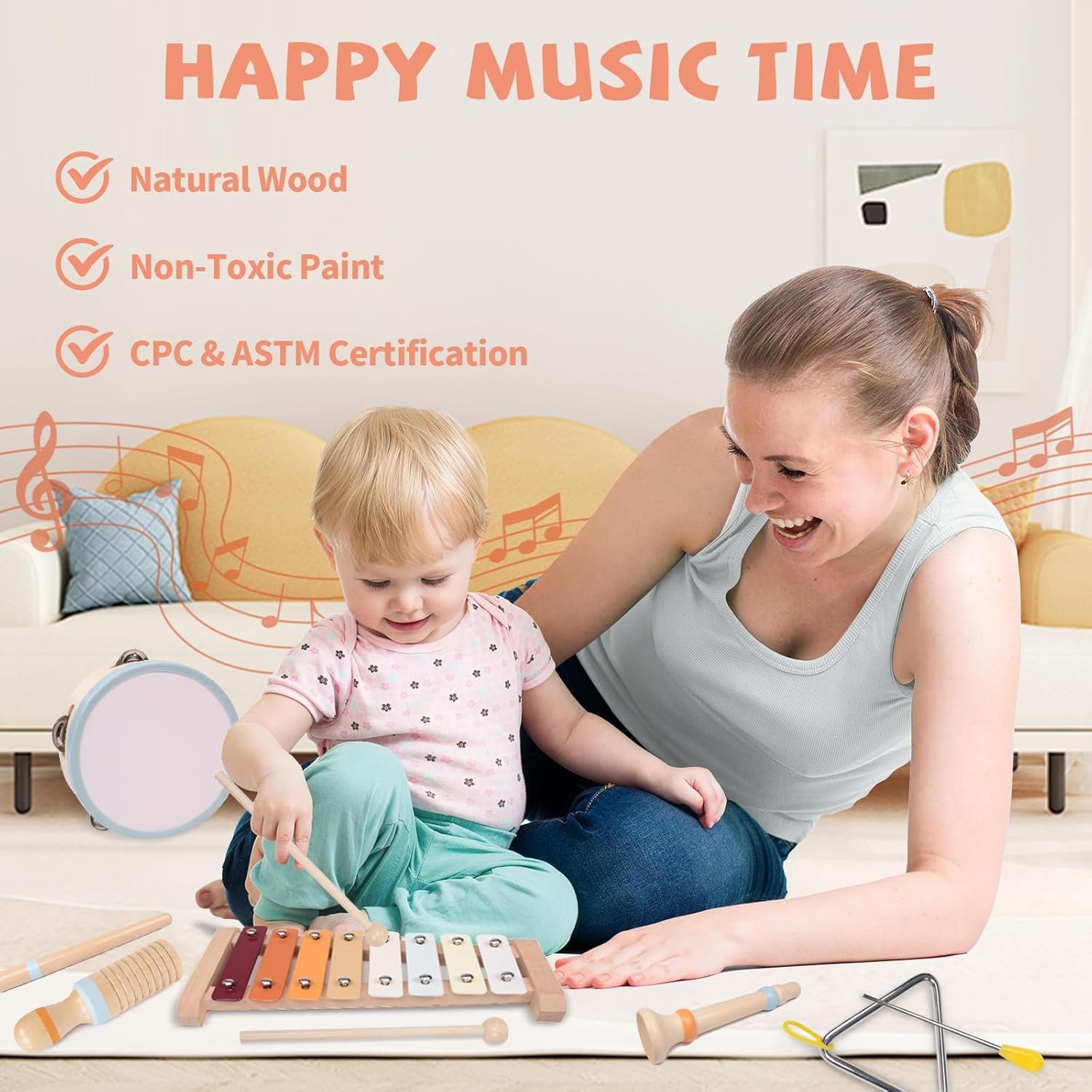
Parents are more cautious than ever about what goes into their children’s toys. With this wooden set, the peace of mind is real: smooth edges, water-based paint, sturdy construction, and a splinter-free finish.
Babies can chew, shake, and bang instruments without the worry of plastic cracking or paint chipping. Every item is designed for little hands, making the set safe from 18 months through preschool years.
Many parents who love wooden learning toys also pair this set with a Montessori Object Permanence Box, a classic developmental tool that complements early music exploration
Rhythm, Sensory Play, and Motor Skills
Children don’t learn rhythm by being shown—they learn through doing. When a toddler shakes a maraca and hears sound instantly, the brain forms powerful connections between movement and feedback.
This baby musical instruments set supports:
Hand-eye coordination
Bilateral coordination
Grasp development
Auditory processing
Rhythm recognition
These foundational skills influence later abilities like speech development, reading fluency, and even emotional regulation. Music stabilizes the nervous system and helps toddlers calm themselves through repeated patterns.
Encouraging Independent Play
Montessori theory encourages independence at every stage. baby musical instruments set don’t direct the child—they respond to the child.
Toddlers discover:
“If I shake this, it makes sound.”
“If I tap harder, the noise changes.”
“If I slide the mallet on the xylophone, the tone rises.”
This kind of autonomy helps children build confidence. They feel in control, engaged, and proud of their discoveries.
Optional Complementary Play Equipment
Many parents who enjoy creating a balanced play environment also look for activity gear that encourages whole-body movement alongside sensory toys. A great example is the Slevoo 2-in-1 Baby Jumper & Swing Set, which offers both gentle bouncing and secure swinging for children from 6 months to 5 years. Its foldable metal stand makes setup simple, whether used indoors for daily play or anchored outdoors for fresh-air activity. Families often appreciate how it complements musical and Montessori toys by supporting gross-motor development while still fitting easily into small spaces.
Building Social and Family Bonding
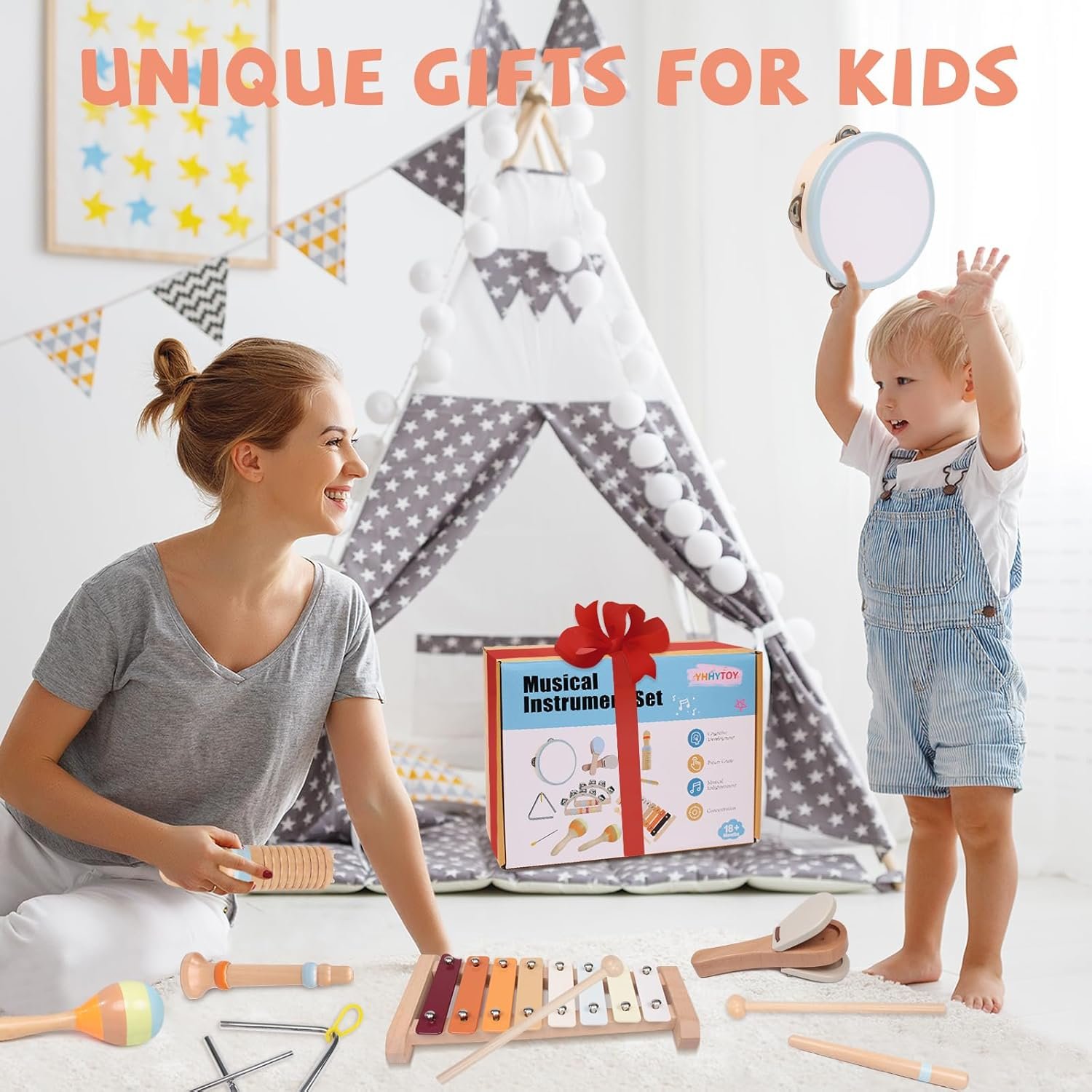
Music is naturally social. Parents often find themselves tapping along, shaking a tambourine to join the rhythm, or forming little “bands” during playtime.
Siblings can participate regardless of age—babies love this baby musical instruments set while older toddlers learn to follow simple rhythms.
This shared play becomes a bonding ritual, especially during bedtime routines, morning play sessions, or rainy afternoons.
Why Wooden Musical Toys Are Better Than Electronic Ones
Electronic toys often overstimulate toddlers with flashing lights and repetitive jingles. In contrast, this baby musical instruments set offers slow, sensory-rich engagement that supports real brain development.
Wooden instruments:
Calm the nervous system
Teach natural sound
Encourage creativity
Strengthen concentration
Promote patience
They let toddlers create sound intentionally—not just press buttons passively.
Supporting Language Development
Sound play and early speech development are deeply connected. When toddlers experiment with rhythm and noise, they exercise the same parts of the brain responsible for pronunciation and speech timing.
This is why speech therapists often recommend simple percussion instruments. The natural cadence of tapping, shaking, and pausing mirrors the rhythmic foundation of language.
Boosting Early Rhythm and Movement
This musical set blends perfectly into a play routine when combined with something more dynamic like the Slevoo 2-in-1 Baby Jumper and Swing, allowing little ones to move freely between sound exploration and active motion. For parents who want to add another enriching element, a simple wooden option like the Montessori Wooden Pound Bench can introduce cause-and-effect play that pairs beautifully with early musical curiosity.
Introducing Music Without Overcomplication
This set doesn’t try to mimic adult instruments. Instead, it respects what an 18-month-old actually needs—just enough variety to stay engaged, but not so much stimulation that the child becomes overwhelmed.
Toddlers learn best from tools that are intuitive and direct. And that’s exactly what this set offers.
Many parents also expand their play space with a Wooden Pikler Triangle, which complements musical play by supporting gross motor development and movement exploration
A Set That Grows With Your Child
At 18 months, toddlers shake, tap, and bang.
At 2 years, they imitate rhythms.
At 3 years, they begin making music patterns.
At 4 years, they learn simple beats and sequences.
This baby musical instruments set evolves naturally with each stage, providing years of use rather than weeks.
Real Wooden Texture Matters
Touch is a central part of early learning. Babies absorb information through texture—smooth wood, gentle curves, and natural grain patterns provide sensory richness that plastic simply can’t match.
Parents who follow Montessori-inspired play appreciate how each instrument feels grounded and warm, not cold or synthetic.
Expanding Sensory Play for Curious Learners
These wooden instruments also work wonderfully alongside broader sensory setups, especially when placed near an outdoor-friendly activity piece like the Step2 Waterpark Wonders Water Table. If you’re looking to round out the musical side of your play area, a compact set such as the Hape Rhythm Kid Musical Set fits naturally with the existing instruments and encourages toddlers to experiment with sound in new ways.
Perfect for Open-Ended Play
One of the biggest strengths of this baby musical instruments set is its open-ended nature. There are no rules, no instructions, no right or wrong way to play.
Toddlers bang on the drum, tap the xylophone, shake maracas, and invent their own games. They aren’t confined to structured outcomes—they’re invited to explore freely.
Helps Reduce Screen Time
Many parents are searching for high-quality alternatives to screen-based entertainment. Wooden musical toys offer a deeply satisfying substitute. They capture attention without overstimulation and teach toddlers how to entertain themselves with movement, sound, and imagination.
Encouraging Confidence Through Mastery
When toddlers discover they can produce recognizable sounds, they feel a burst of pride. This intrinsic motivation leads to repeated practice—shaking maracas more intentionally, tapping with more precision, or trying to copy a rhythm the parent demonstrates.
Every successful moment builds confidence, and confidence fuels autonomy.
A Great Starter Set for Future Music Lessons
While babies and toddlers don’t need structured lessons, early exposure to rhythm and percussion lays a strong foundation for future music learning. Many children who start with wooden percussion toys develop:
Improved rhythmic timing
Better sound discrimination
More expressive movement
Higher sensory awareness
This foundation helps if they later pursue piano, violin, guitar, drums, or other instruments.
Safe for Group Play and Playdates
The set includes multiple instruments, making it ideal for siblings or small groups. Toddlers can choose their favorite instrument, switch during playtime, and mimic each other’s movements.
Group music play encourages cooperation, sharing, and turn-taking—skills toddlers naturally struggle with but gradually learn through repetition.
Wooden Design That Blends Into Home Aesthetics
Unlike loud plastic toys that clash with home décor, this baby musical instruments set offers a natural, minimalist appearance. The soft colors and wooden texture fit beautifully in Montessori-inspired playrooms, neutral nurseries, and modern living spaces.
Easy to Store and Organize
Many parents place the instruments in a small basket or tray so toddlers can access them independently. This reinforces Montessori principles of order and responsibility, teaching children to take instruments out and put them away without adult prompting.
Music as a Foundation for Early Development
Long before toddlers speak their first words, they already understand rhythm in a deep, instinctive way. Heartbeats, rocking motions, soft tapping—these cues shape their earliest understanding of the world. A baby musical instruments set taps directly into this developmental foundation by giving babies tangible tools to explore rhythm with their hands.
When babies shake a maraca or tap a tambourine, they learn that their movement makes sound. This cause-and-effect awareness is one of the earliest building blocks of cognitive development. It teaches intention, repetition, anticipation, and control. Every time toddlers repeat a sound just to hear it again, their brains make new neural connections that strengthen memory and coordination.
Why Babies Naturally Gravitate Toward Instruments
There’s a reason babies crawl toward anything that rattles. The moment they hear a sound, they want to grab it, explore it, rotate it, and repeat it. A baby musical instruments set appeals to that natural curiosity.
Unlike plastic toys that bombard the senses with random melodies, wooden musical instruments offer a calming, predictable sensory experience. Each shake produces a consistent tone. Each tap results in a clear sound. Toddlers crave this reliability because it helps them understand that their actions have meaning and outcomes they can predict.
Montessori Principles in Action
Montessori play focuses on giving children real tools, not toy versions of adult items. This is why wooden musical sets are so effective—they are intentional, natural, and grounded in real sensory experiences.
Instead of teaching through instructions, Montessori toys allow children to learn through exploration.
A baby musical instruments set is one of the most Montessori-aligned toys because:
It encourages self-guided discovery
It builds attention through real sensory feedback
It doesn’t overstimulate with lights and electronics
It promotes movement and coordination rather than passive play
It supports rhythmic learning, which aligns with early language development
It lets toddlers repeat tasks independently without adult intervention
These principles align perfectly with the needs of toddlers aged 18 months to 3 years, who are rapidly building independence.
Developing a Musical Ear Early
Even before they walk confidently, babies begin recognizing pitch, tempo, volume, and sound patterns. This early sensitivity to sound influences language development and emotional regulation.
When a toddler uses the xylophone in a baby musical instruments set, they begin noticing:
Higher vs. lower tones
Louder vs. softer tapping
Fast rhythms vs. slow patterns
These distinctions might seem simple, but they are neurologically significant. The brain processes language and musical rhythm in overlapping regions. This is why children exposed to music early often develop clearer speech patterns, stronger memory retention, and better auditory comprehension.
The Unique Value of Wooden Sound
Parents often don’t realize how different natural wooden sound is from plastic sound. Plastic creates sharp, hollow tones that overstimulate quickly.
Wood, however, produces:
Warm resonance
Gentle volume
Soft tactile feedback
A grounded acoustic tone
These qualities soothe the nervous system rather than overwhelm it. Toddlers with heightened sensory sensitivity respond especially well to wooden instruments because they provide stimulation without chaos.
Strengthening Fine Motor Skills
Every movement involved in playing with a baby musical instruments set supports fine motor growth. Toddlers learn to:
Grasp mallets
Pinch castanets
Shake maracas with control
Hold tambourines using wrist rotation
Tap xylophone bars using controlled arm movement
These repeated actions build hand strength, finger agility, and wrist stability. Fine motor development at this age affects future tasks such as holding pencils, using utensils, cutting with scissors, tying shoes, and eventually handwriting.
Parents often don’t realize that musical play is one of the most effective early-motor activities.
Encouraging Cross-Body Movement
Cross-body movement—using one side of the body to coordinate with the other—is essential for brain lateralization.
When toddlers tap a xylophone with both hands or shake a tambourine while shifting weight, they train their brain to communicate across hemispheres.
A baby musical instruments set naturally encourages:
Crossing midline
Alternating hands
Coordinated bilateral hand movements
Rhythmic whole-body swaying
These patterns support balance, gait development, and spatial awareness.
Creating a Montessori Music Corner at Home
Parents often ask how to create a music space that encourages daily use without overstimulating the child. The key is simplicity and accessibility.
A Montessori-aligned music area typically includes:
A small tray or basket with instruments
A low shelf so toddlers can access items independently
A soft rug for seated play
A wooden xylophone
A pair of maracas
A simple tambourine
A small drum
A few bells or castanets
By providing only a few items at a time, toddlers stay focused. Rotating instruments weekly keeps interest high without overwhelming the child.
Music as a Family Ritual
One of the most beautiful things about a baby musical instruments set is how easily it becomes a part of family rituals.
Some families begin their day with a “morning rhythm”—light tapping on the xylophone or a shaker routine while singing a simple greeting song.
Others use music before nap time to help toddlers release energy.
Evening music play—right after dinner or before bath time—helps toddlers regulate emotions after a long day.
These tiny rituals support emotional bonding while building predictable structure into the child’s day.
Building Emotional Expression Through Sound
Toddlers feel emotions intensely but often lack the words to express them. Instruments offer a safe outlet:
Fast shaking can express excitement
Soft tapping can express calmness
Drumming can release frustration
Maraca rhythm can release joy
Music play validates feelings and teaches toddlers how to express emotions constructively. Over time, this improves emotional intelligence and helps reduce tantrums because toddlers learn how to channel emotions through action.
Supporting Speech Development
Speech therapists often incorporate rhythm exercises into early intervention because rhythmic awareness shapes how children process language.
Tapping slowly builds pacing.
Shaking steadily builds timing.
Repeating beats builds motor planning.
Using a baby musical instruments set at home reinforces these patterns naturally. Toddlers who engage in rhythmic play show stronger pre-linguistic skills, earlier word combinations, and better sound imitation.
Encouraging Cooperative Play
Although toddlers begin with parallel play—playing beside each other rather than with each other—music is one of the first activities that encourages true cooperation.
When two toddlers shake maracas together or follow a parent’s beat, they naturally fall into a rhythm as a group. They watch one another, imitate one another, and adapt their own movements to match.
This builds early social awareness, turn-taking ability, and response inhibition.
A Great Travel and Outdoor Activity
Because this baby musical instruments set is lightweight, portable, and quiet compared to electronic toys, it’s perfect for:
Picnics
Playdates
Beach trips
Grandma’s house
Cars
Outdoor music time at parks
Parents can bring two or three small instruments along to transform any outing into an engaging, sensory-rich experience.
Creating Sensory-Friendly Play for Children With Special Needs
Many children with sensory needs are drawn to calm, predictable sound play. Wooden instruments offer:
Consistent volume
Structured rhythm
Gentle vibrations
Tactile grounding
This predictability makes them excellent tools for children with ASD, SPD, or sensory-seeking behaviors.
Music becomes a bridge between sensory exploration and emotional expression.
Supporting Preschool Readiness
Preschool teachers often use musical routines daily. Toddlers who grow up with regular rhythm play enter preschool with noticeable advantages:
Better coordination
Improved focus
Longer attention span
More confidence in group activities
Better impulse control
Music strengthens executive functioning—the mental skills toddlers rely on to listen, follow instructions, pause when needed, and stay engaged during group time.
Durability That Outlasts the Toddler Years
A well-made baby musical instruments set isn’t disposable—it becomes a long-term part of play. High-quality wooden instruments withstand years of tapping and shaking without cracking or breaking. They age gracefully, developing a smoother patina rather than wearing down.
This durability makes the set a practical investment instead of a fast-disappearing novelty.
Encouraging Creativity Without Overstimulation
Most modern toddler toys rely on lights, screens, and repetitive jingles. But creativity develops when children use their bodies and imagination—not when they press a button.
Wooden musical instruments encourage toddlers to invent their own rhythms, create sound patterns, dance freely, and develop musical memory.
This supports deeper creativity and flexible thinking than pre-programmed toys ever could.
Why Toddlers Love Repetition in Music
Toddlers repeat actions because repetition builds mastery. When a child repeatedly hits the same xylophone bar or shakes a maraca with a steady beat, they are building the foundational neural pathways for memory and motor coordination.
Repetition is not boredom—it is learning.
A baby musical instruments set provides endless opportunities for healthy repetition without overstimulation.
Long-Term Educational Benefits
As children grow, the musical habits they form early can support future learning:
Better reading rhythm
Stronger memory
Improved pronunciation
Better math pattern recognition
Higher concentration
Music fundamentally strengthens the same brain circuits used for academic learning.
The Emotional Legacy of Music
Long after toddlers outgrow maracas and tambourines, they carry emotional memories of musical bonding with their family.
Music becomes a nostalgic anchor—a source of comfort, connection, and joy.
This emotional richness is what makes a baby musical instruments set far more meaningful than a standard toy.


